

Life is made of projects: Oranne Corelli’s journey to Madagascar
by Alberto Valverde M.
Antananarivo sits on a ridge of hills in the centre of Madagascar, a city of red-earth roads, terraced rice paddies, and traffic that moves on its own terms. It is not where most people imagine they will end up living. But every morning Oranne Corelli navigates through it, to an office where a team of fifteen people are rebuilding the country’s largest professional event organisation from the ground up.
A graduate of the Master in Strategic Management for Global Business at Università Cattolica del Sacro Cuore's ALTIS Graduate School of Sustainable Management, Corelli now leads Madavision while pursuing a mission that has taken her from volunteering in New York to humanitarian work across Africa and, ultimately, to building a life in Madagascar.
Oranne grew up in the French-speaking part of Switzerland. She studied Political Science in Lausanne, spent a year in Barcelona on Erasmus, and by the time she was in her early twenties she had already been involved in charity work, starting small, helping out in local associations in her hometown, then coordinating youth projects for a children's foundation over several years.
But if there is an origin point, it is New York. Just fresh out of high school, she spent four months volunteering with Metro World Child, an NGO that works with children growing up in some of the city's most underserved neighbourhoods. After that experience she came back with something that has never left her, the conviction that she had been lucky, and that luck came with a responsibility to give back.
Always with the same conviction, she realized something: NGOs were often under-managed. Good intentions, poor execution. "If we want to help people, we need to be efficient, we need to be well organised, we need to have goals," she says. "Those things, I wanted to learn from a business perspective and bring them into the NGO world." She enrolled in Cattolica's Master in Strategic Management for Global Business in Milan – a one-year programme at ALTIS Graduate School of Sustainable Management, intense by design, which suited her perfectly. "I like when things go fast."
In Milan, the programme gave her more than technical management tools. It gave her a structured way to work across cultures, expectations, and professional habits. The programme brought together students from across Europe, Asia, and beyond, and much of the work happened in groups. For Oranne, already shaped by years of moving between cultures, it was the first time she had to navigate professional differences in a structured setting – a Swiss student working alongside Spanish, Indian, Serbian, and Russian classmates, each with their own way of doing things. "It was so, so different," she says. "Now that I work in Madagascar full-time, that experience was definitely a first step into working with a different culture."
She was also running Cadesio alongside her studies – a social chocolate company she had co-founded with two other women, where each product supported a different cause, from environmental programmes to mental health initiatives. The classroom and the company fed each other directly. "I was learning things in class, and I could just apply them in my business. It was a perfect match." She graduated in 2020. Six years later she still goes back to her old course notes.
“In Madagascar and every day, I think back of my master's programme and I'm like, oh yes, I remember this class. Last week I actually went back to look for content that I had in a specific class.”
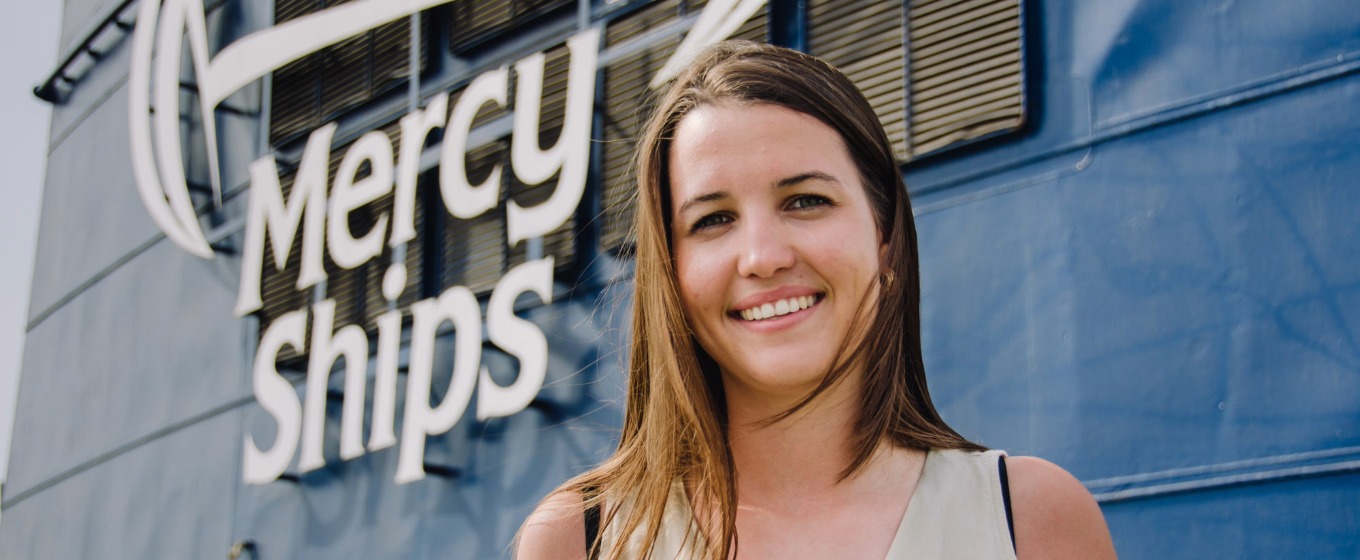
After finishing her masters, Mercy Ships, the organisation that runs the world's largest civilian hospital ship, entered the picture. COVID hit, and like many people she found herself reassessing. A chance advertisement for a volunteer media liaison role changed her mind. She signed up for a year.
Within six months they asked her to stay on as an employee. What followed took her across West Africa – Senegal, Sierra Leone, and eventually Madagascar, working as the bridge between the organisation's American leadership and local governments. It was demanding in ways she had not anticipated, and not only logistically. "Being resilient in what you see, in the injustice of the world," she says. "I ask myself every day, why not me – why did I grow up where I grew up?" She never found a clean answer. But the question kept her moving.
In Madagascar, she found more than work. She met her husband and decided to stay. When her time with Mercy Ships came to a natural end, she spotted something others had overlooked: Madavision, once the country's most recognised events company, had gone dormant. Together with a co-director, she decided to bring it back to life.
The pivot from humanitarian work to private sector leadership was deliberate. Years inside the NGO world had convinced her that sustainable change looks different from the ground up. "My way of creating social impact today is strictly giving jobs to people and trying to create the best environment my employees can have," she says. Her team of fifteen, most of them young and in their first professional role, are the proof of that. "In just one year, seeing them grow the way they're doing is just so rewarding."
Madavision now runs Madagascar's three largest trade fairs, and Oranne's ambition is to make them a genuine gateway for international investment into the country. It is, in its own way, another project in a life built entirely out of them. "I never thought I would end up having my own company in Madagascar," she says. "But every single experience I had before prepared me to be here." She has no idea where she will be in ten years. But she will tell you that is exactly the point.